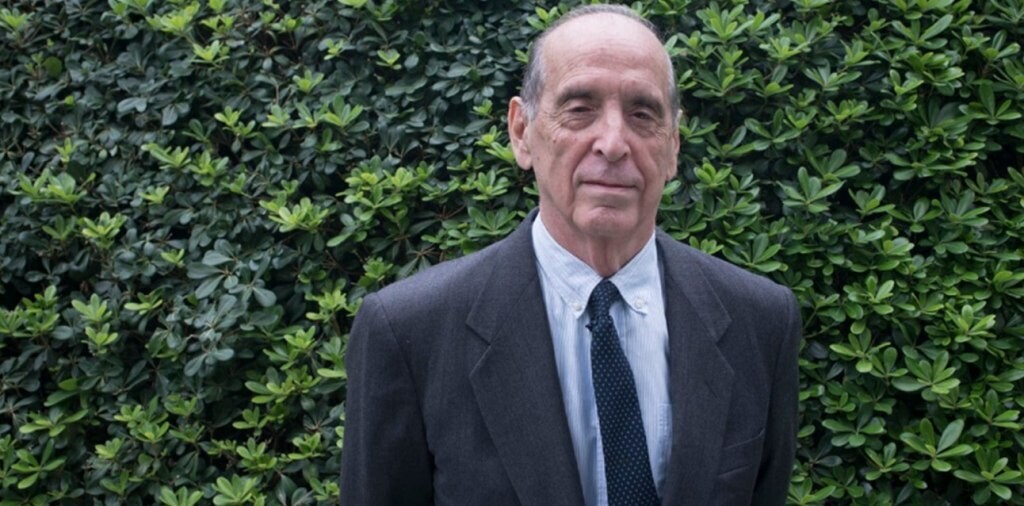
Economist Ricardo Arriazu commented on the exchange rate band system, where the government of Javier Milei allowed the dollar to float, and again emphasized the need for the libertarian administration to accumulate reserves. According to the Argentine News Agency (NA) with information from Clarín, the economist expressed his position on the floating of the dollar and the accumulation of reserves by the Central Bank (BCRA). Last week, Minister of Economy Luis Caputo reaffirmed the band system. Arriazu, who is one of the most respected professionals by Milei, stated that accumulating reserves and having a floating exchange rate means a "dirty float", where intervention "must prevent the peso from appreciating and, on the contrary, the objective should be for the exchange rate to depreciate". Arriazu explained that the proposal is "a bit more sophisticated" as it "involves a daily target for purchasing foreign currency, with total indifference to the possible evolution of the exchange rate". And he argued: "In response to the question of who would buy the currencies, the answer is: either the Treasury - which would reassure the markets by ensuring debt payment - leaving aside that this way gross reserves would increase, but not net ones; or the Central Bank itself by issuing money". Arriazu again insisted on the accumulation of reserves. In this sense, he indicated that under these arguments, the accumulation of reserves would be made through the current account (favorable balances in the trade balance and other service accounts) because "devaluation would improve the country's external competitiveness, raising the growth rate and the export of goods and services, while at the same time lowering imports". And he highlighted a study by the think tank Bruegel, which shows that Argentina and 178 other countries "show that any rapid increase in the real exchange rate initially lowers the level of economic activity, reduces imports, but does not rapidly increase exports". "However, these experiences are always ignored", he warned. The economist analyzed the accumulation of reserves through favorable balances in the current account of the balance of payments with the experience of Latin America and the Caribbean during the period 1980-2024. Arriazu details that all countries in this group accumulated negative balances equivalent to US$2.47 trillion, with only five years of "small positive balances" (2003-2007), and a joint maximum deficit of US$198 billion in 2014. Only two countries registered positive results: Venezuela (US$222 billion) and Trinidad and Tobago (US$67 billion); the largest deficit was obtained by Brazil, with US$1.18 trillion, while Argentina recorded a cumulative deficit of US$196 billion. "Argentina needs to accumulate reserves, but it will not do so through the current account, but through the capital account". "Argentina needs to accumulate reserves, but it will not do so through the current account (although the planets are aligning in our favor) but through the capital account, when confidence is restored and the government can return to voluntary credit markets". However, Arriazu emphasized that "timely rains" would allow for record wheat and barley harvests, and at the same time "good prospects" for corn, soybeans, and sunflower crops. This, according to the economist, "would increase the value of the harvest by more than US$5 billion, and even more if recent increases are taken into account". In the energy sector, he forecast a favorable balance of US$4 billion in 2026 and US$7 billion in 2027, allowing "to improve the trade balance, even with significant increases in imports". At the end, he stated that to restore confidence, it is necessary to restore macroeconomic balances, and at the same time, that "those who bet against the peso lose at some point, to avoid new runs in 2026 and 2027". And he specified on the financial aid from the United States: "It is very important in this regard (money to solve a liquidity problem, not to spend), but even more important is not to make a mistake in managing economic variables. Let's hope it is so".